Lite Sorbents
We offer a wide range of pads, rolls, socks, mats and rugs designed to prevent slips, quickly absorb moisture, and contain and soak up spills. Strong and effective, our lite sorbents are affordable and come in a number of materials for a variety of industrial applications, including hazardous material spills, caustic fluid containment, and static-dissipative needs. We also carry professional spill kits, containment products, and drain covers.
We can order the full line of lite sorbents from our partners, Meltblown
Universal Absorbents and Gray All-Purpose Sorbent Pads
Gray universal absorbent pads and rolls absorb oil, water, glycols, gasoline, diesel, hydraulic fluids and most chemicals.
Gray Fine Fiber Universal Absorbents
Fine fiber meltblown polypropylene sorbents have a soft, super-absorbent fiber that resembles tissue paper. We thermally bond a thin layer to each side of our standard, coarse-fiber, meltblown polypropylene. These composites absorb quickly, remove the sheen, and grip cement floors.
Dimpled Absorbents
Dimpled meltblown polypropylene sorbents are single-layer, economical sorbents. This media passes through a thermal bonder, which ties down loose fibers. Dimpled sorbents are also perforated, which promotes waste minimization.
Spunbond Universal Absorbents
Spunbod meltblown polypropylene sorbents have an exceptionally strong, ultra-light nonwoven that resembles polyester. This fabrics high level of tensile strength and durability does not hinder its absorption capabilities. Thicker fluids penetrate the spunbond membrane and saturate the highly absorbent meltblown center layer.
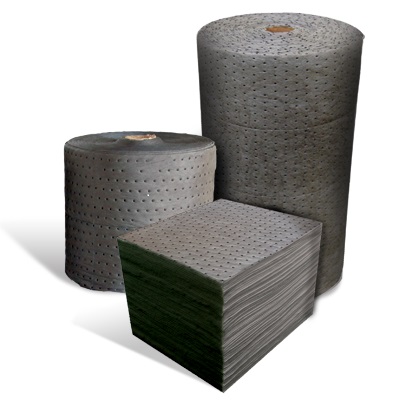
| Item # | Description | Roll/Pad Size | Absorption (Gallons) | Quantity per pkg. | Package Weight | Units/Pallet |
| GFMF150 | Gray universal heavy weight absorbent rolls. Low lint. | 30" x 150' | 50.5 | 18 | 23 lbs. | 18 |
| GDML100 | Gray universal medium weight absorbent pads. Dimpled and perforated. | 15" x 18" | 20.6 | 100 | 9.4 lbs. | 36 |
| GSMS100 | Gray universal heavy weight absorbent pads. Spunbond, dimpled, perforated and durable. | 15" x 18" | 19.6 | 100 | 11.5 lbs. | 30 |
Standard Polypropylene Oil Only Sorbents
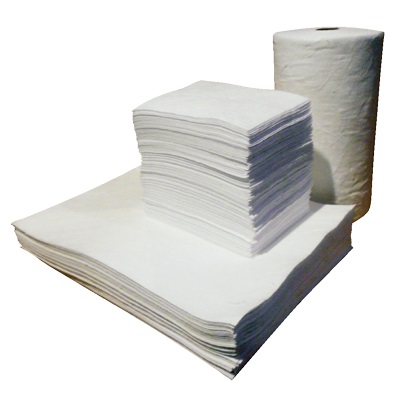 Meltblown standard oil only sorbents are typically used to skim oil off of water. The open fiber construction draws hydrocarbon-based fluids into the center of the pads and/or rolls, while repelling water. This type of media is our most economical family of pads and rolls, yet it absorbs quicker and more than the other product families.
| Item # | Description | Pad Size | Absorption (Gallons) | Quantity | Package weight |
| WM100 | White oil only heavyweight pads. | 15" X 18" | 28 | 100 | 11.5 lbs. |
| WDML100 | White oil only mediumweight absorbent pads, dimpled and perforated | 15" X 18" | 20.6 | 100 | 9.4 lbs. |
| WDM100 | White oil only heavyweight pads.Dimpled and perforated. | 15" X 18" | 25.2 | 100 | 11.5 lbs. |
| WDM200 | White oil only lightweight pads.Dimpled and perforated. | 15" X 18" | 25.2 | 200 | 11.5 lbs. |
Sorbent Socks
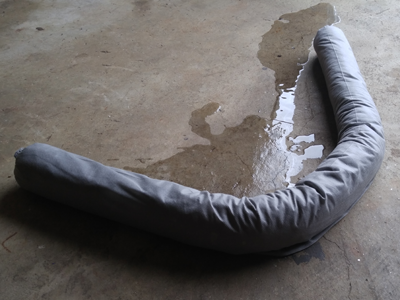
MBT absorbent socks can be used in numerous ways. Our general socks protect drains and keep fluids from seeping into walkways, and oil only socks are used to skim oil off of water and to keep water from entering doorways. Industrial absorbent socks are ideal for cleaning up spills around machine bases, equipment as well as chemical spills. Our absorbent polypropylene socks soak up oil, coolant, solvents, water and aggressive chemicals. MBT cellulose (made from paper) absorbent socks absorb the most liquids.
| Item # | Description | Size | Absorption (Gallons) | Package Quantity | Package Weight | Pallet Quantity |
| GPS348-30 | Universal Absorbent Sock - General purpose, gray. Suitable for most applications | 3" X 4' | 25.2 | 30 | 30 lbs. | 16 |
| OS348-30 | Oil Only Absorbent Sock - White. Specialized to selectively absorb oil and repel water | 3" X 4' | 25.2 | 30 | 30 lbs. | 16 |
| CELS348-40 | Cellulose Absorbent Sock - Universal cellulose sock, gray. Provides increased absorbency | 3" X 4' | 25.2 | 30 | 30 lbs. | 16 |
Universal Trucker SpillKit
Be ready for any spill. Kit includes a variety of sorbents to handle smaller spills of oils, coolants, solvents or water that truckers encounter on a regular basis. Absorbs up to 8.7 gallons per kit. High quality, fast wicking and great durability. Perforated, so you use only what you need. Comes in a clear bag, to allow quick access to absorbents and easily fits behind the seat for safe storage.
GPSK-TRK
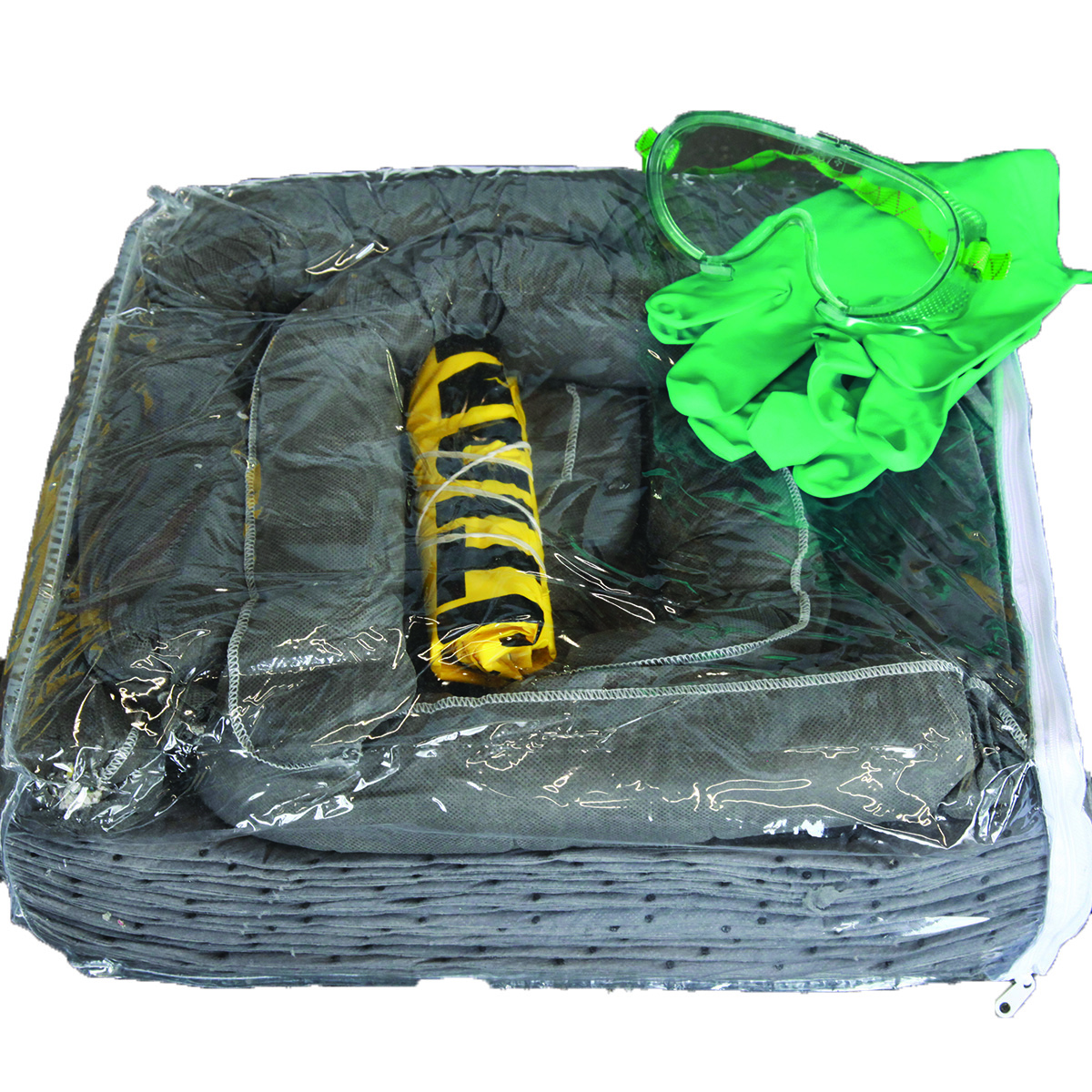
Kit includes:
- 20 – 15”x 18” pads
- 3 – 3”x 4’ Socks
- 1 pair Gloves
- 1 pair Safety Goggles
- 1 – Disposable bag with tie
- 1 – Clear Vinyl Zippered Bag